









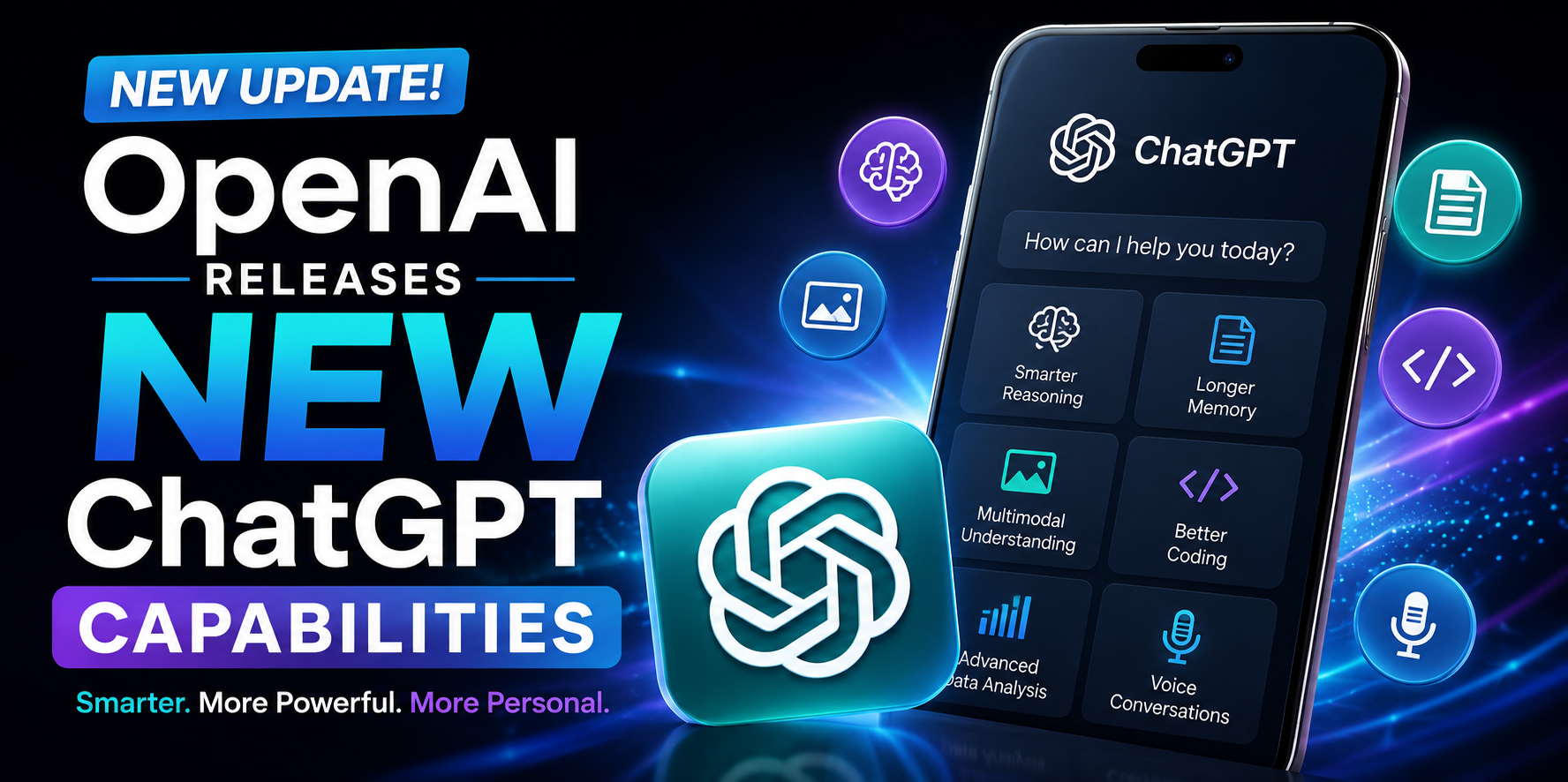
Open AI has unveiled another wave of enhancements for ChatGPT, introducing a range of new capabilities designed to make the AI assistant more intelligent, personalized, and productive. The latest updates continue the company’s rapid pace of innovation, giving users improved tools for research, coding, creative work, business productivity, and everyday problem-solving. The announcement highlights OpenAI’s ambition to transform ChatGPT from a conversational chatbot into a comprehensive AI assistant capable of handling increasingly complex tasks.
The newest improvements focus on making interactions with ChatGPT more natural and efficient. Users can now benefit from stronger reasoning abilities, expanded memory features, improved multimodal understanding, and enhanced support for longer conversations. These additions allow ChatGPT to remember relevant user preferences over time, interpret images and documents more accurately, and deliver responses that better match individual needs. OpenAI says the goal is to reduce repetitive prompts while helping users complete projects faster.
One of the most notable developments is the continued expansion of ChatGPT’s memory system. Instead of relying solely on manually saved information, the assistant can intelligently update and organize relevant details over time. This enables more personalized conversations without requiring users to repeatedly explain their preferences or ongoing work. Users remain in control of memory settings and can review or delete stored information whenever they choose.
OpenAI has also strengthened ChatGPT's ability to work across multiple content formats. The assistant can now analyze documents, interpret images, generate visuals, assist with spreadsheets, summarize lengthy reports, and support voice-based conversations within a unified experience. These multimodal capabilities continue to expand the ways people interact with artificial intelligence for both professional and personal tasks.Developers and technical users are expected to benefit from improvements in coding assistance. ChatGPT now provides faster debugging, clearer explanations of complex code, and better support for large software projects. OpenAI has invested heavily in making the AI more reliable when generating code while improving its ability to reason through multi-step programming challenges. These enhancements are aimed at reducing development time and increasing productivity for software engineers.
Business users are another major focus of the latest release. Organizations using ChatGPT can take advantage of updated memory controls, simplified model selection, and productivity-focused improvements designed for enterprise workflows. Teams can switch between different reasoning levels depending on the complexity of their work, allowing employees to balance speed with deeper analytical capabilities.
Security also plays a significant role in the latest updates. OpenAI has introduced additional account management features that allow users to monitor active login sessions across devices. The new controls make it easier to identify unfamiliar activity and remotely sign out of sessions if necessary. These additions reflect the company’s ongoing effort to strengthen account security as ChatGPT becomes increasingly integrated into users’ daily workflows.
The latest improvements arrive amid growing competition in the artificial intelligence industry. Major technology companies continue to invest billions of dollars in advanced AI models, leading to increasingly rapid product development. OpenAI’s newest capabilities are intended to maintain ChatGPT’s position as one of the world’s leading AI assistants by offering stronger performance, broader functionality, and a more personalized user experience.
Industry analysts believe AI assistants are evolving far beyond simple question-and-answer systems. Modern AI platforms are increasingly capable of planning projects, generating creative content, assisting with research, writing software, analyzing data, and automating repetitive tasks. These developments suggest that AI will become an essential productivity tool across education, healthcare, finance, software development, and many other industries over the coming years.
Meanwhile, OpenAI continues to invest in its underlying AI models. Recent announcements describe ongoing improvements in reasoning quality, efficiency, safety, and affordability across its latest model family. The company says its newest models are designed to deliver stronger performance while maintaining robust safeguards against misuse. Some advanced releases are currently undergoing staged deployment with additional safety evaluations before wider availability.
The gradual rollout reflects the growing emphasis on responsible AI development. As artificial intelligence becomes more capable, governments, researchers, and technology companies are placing greater attention on safety testing and risk assessment. OpenAI has stated that balancing innovation with responsible deployment remains a central priority as increasingly powerful AI systems become available to businesses and consumers.
For students, ChatGPT’s expanding capabilities offer improved support for learning, language assistance, research, and academic writing. Educators can also use the platform to generate lesson plans, explain difficult concepts, and create personalized learning materials. At the same time, OpenAI continues to encourage responsible use of AI in educational environments, emphasizing that AI should complement rather than replace independent thinking and critical analysis.
Creative professionals are expected to see benefits as well. Writers, designers, marketers, and content creators can leverage ChatGPT for brainstorming ideas, editing documents, generating images, organizing campaigns, and producing multimedia content more efficiently. By combining text, image, and analytical capabilities, the platform aims to support increasingly complex creative workflows from a single interface.
Looking ahead, OpenAI’s latest announcements suggest that ChatGPT will continue evolving into a comprehensive digital assistant capable of handling a wide variety of personal and professional responsibilities. Rather than functioning solely as a chatbot, the platform is steadily becoming an intelligent workspace where users can research information, collaborate on projects, automate repetitive tasks, and create content across multiple formats.
As competition in artificial intelligence accelerates, users can likely expect even more frequent updates introducing smarter reasoning, broader automation, stronger personalization, and enhanced security. For now, OpenAI’s newest ChatGPT capabilities represent another important milestone in the rapid evolution of consumer AI, demonstrating how intelligent assistants are becoming an increasingly valuable part of everyday digital life.