









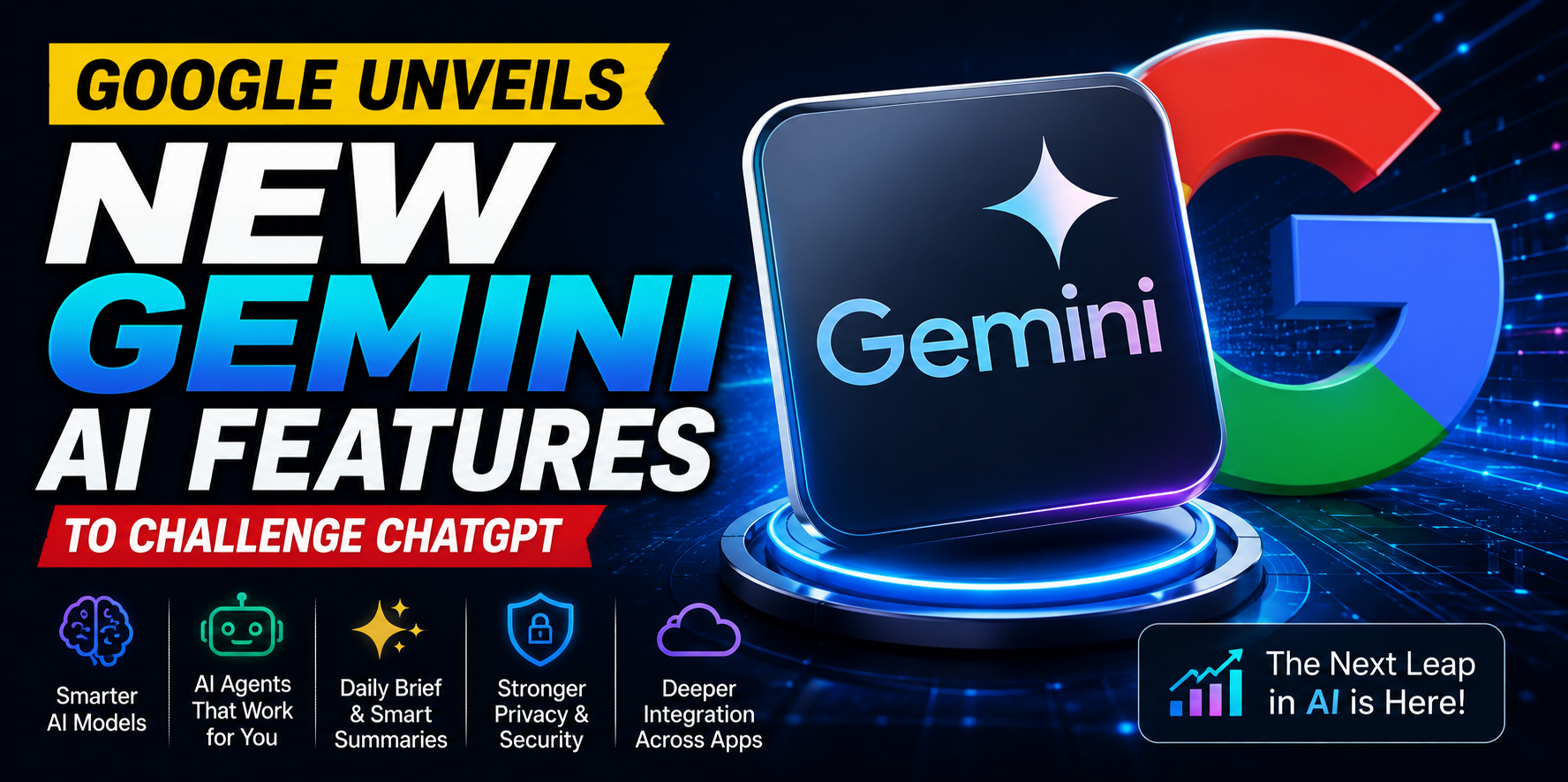
New models, smarter AI agents, and deeper integration across Google’s ecosystem signal the company’s biggest AI push yet.
Mountain View, California – Google has introduced a major wave of artificial intelligence innovations, revealing new Gemini capabilities that aim to make its AI assistant faster, smarter, and more useful in everyday life. The announcements, made during the company’s annual Google I/O developer conference, demonstrate Google’s determination to compete more aggressively in the rapidly evolving AI market, where companies are racing to build the most capable digital assistants.
The latest updates go well beyond simple chatbot improvements. Google is transforming Gemini into an AI system that can understand context, complete complex tasks, assist with coding, organize information, and even take action on behalf of users. With new AI models, redesigned applications, and intelligent automation tools, the company hopes Gemini will become an essential companion for work, learning, and creativity.
Gemini 3.5 Flash Takes Center Stage
One of the biggest announcements was the arrival of Gemini 3.5 Flash, Google’s newest AI model designed to deliver advanced reasoning while maintaining impressive speed. According to Google, the new model is built specifically for “agentic” tasks—jobs that require planning, reasoning, and completing multiple steps instead of simply answering a single question.
Unlike previous AI assistants that mainly responded to prompts, Gemini 3.5 Flash is designed to help users accomplish real work. Whether someone needs to analyze documents, write software, summarize research, or organize large projects, the new model aims to complete these tasks more efficiently while reducing waiting times.
Google says Gemini 3.5 Flash also delivers better coding performance, stronger logical reasoning, and improved multimodal understanding, allowing it to process text, images, and other forms of information within the same conversation.
Introducing Gemini Spark
Perhaps the most ambitious announcement was Gemini Spark, a new AI agent that moves beyond traditional chatbot interactions.
Instead of waiting for users to ask questions, Gemini Spark is designed to work in the background, helping organize schedules, monitor tasks, manage information, and automate repetitive work. Google describes Spark as a step toward proactive AI assistants that can complete long-running tasks with minimal supervision.
For professionals, this could mean automatically preparing meeting summaries, organizing emails, tracking projects, or gathering research while they focus on more important work.
Industry experts believe this represents one of the biggest shifts in consumer AI since conversational assistants first became popular.
A Smarter Gemini App
Google also revealed a completely refreshed Gemini application featuring a cleaner design, smoother animations, and easier navigation across Android, iOS, and the web. The redesign focuses on making conversations feel more natural while giving users quicker access to powerful AI tools.
The updated interface allows users to switch seamlessly between typing, speaking, uploading images, or sharing documents during the same conversation. Instead of treating each request separately, Gemini can maintain context across longer interactions, creating a more fluid experience.
The redesign reflects Google’s broader strategy of making AI feel less like a search tool and more like a personal assistant.
Daily Brief Brings Personalized AI
Another highlight was Daily Brief, an intelligent feature that creates personalized summaries using information from Gmail, Calendar, tasks, and other Google services.
Rather than manually checking multiple apps every morning, users can receive a concise overview of important meetings, emails, deadlines, and reminders generated by Gemini.
The feature aims to save time while helping people stay organized throughout busy workdays.
AI Across Google’s Entire Ecosystem
Google isn’t limiting Gemini to one application.
The company announced deeper integration across many of its most popular services, including Search, Workspace, YouTube, Android devices, and developer tools. This means AI assistance will become increasingly available wherever users already spend their time.
Google Search is receiving one of its largest AI upgrades in years, with Gemini helping users discover information through more conversational interactions instead of traditional keyword searches. Developers will also gain expanded access to Gemini through APIs and Google’s development platforms, making it easier to build AI-powered applications.
Stronger Competition in the AI Industry
Google’s latest announcements arrive during an intense period of competition in artificial intelligence.
Over the past few years, AI assistants have become central products for major technology companies. Businesses, students, software developers, educators, and content creators increasingly rely on AI to improve productivity and reduce repetitive work.
By introducing faster models, autonomous AI agents, and broader software integration, Google hopes to strengthen Gemini’s position against competing AI platforms while attracting more users to its ecosystem.
Rather than focusing solely on generating text, today’s AI companies are racing to create assistants capable of solving real-world problems, completing workflows, and acting as intelligent digital partners.
Developers Receive New Opportunities
Software developers are among the biggest beneficiaries of Google’s latest AI upgrades.
Gemini 3.5 Flash offers stronger programming assistance, improved debugging, faster code generation, and better support for complex development projects. Google also introduced additional tools for developers building AI-powered applications, allowing them to integrate Gemini into websites, mobile apps, and enterprise software.
As businesses continue investing in AI automation, these developer-focused improvements could accelerate adoption across industries ranging from healthcare and education to finance and retail.
AI Becomes More Personal
Another noticeable trend in Google’s latest strategy is personalization.
Instead of providing identical responses to every user, Gemini is gradually becoming better at understanding individual preferences, ongoing projects, and recurring tasks. This enables the assistant to deliver more relevant suggestions while reducing the need for repetitive instructions.
Google says these personalized experiences are designed to save users time while maintaining transparency and user control over personal information.
Looking Ahead
Google’s newest Gemini announcements make one thing clear: artificial intelligence is evolving beyond chatbots.
The company’s latest AI models are designed to understand context, automate workflows, assist with creative projects, support software development, and organize everyday life. As these capabilities continue expanding, AI assistants are becoming practical productivity tools rather than simple question-and-answer systems.
While competition with other leading AI platforms remains intense, Google’s newest Gemini upgrades demonstrate that the race is entering a new phase—one where success depends not only on answering questions but also on helping people accomplish meaningful work.
For consumers, businesses, and developers alike, the latest Gemini features offer a glimpse into the future of AI-powered computing. As Google continues rolling out these capabilities over the coming months, users can expect digital assistants to become faster, more capable, and more deeply integrated into the technology they use every day.